
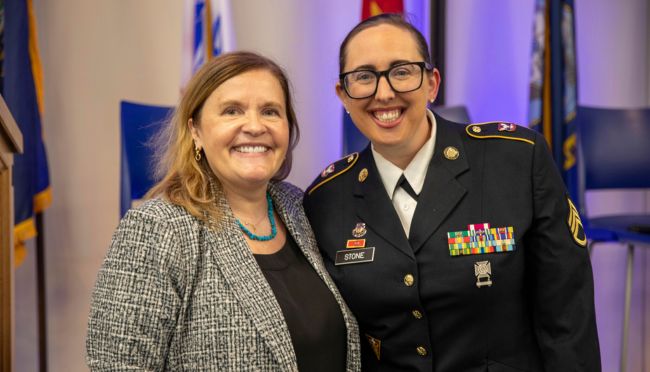
On November 7, we were on Southern New Hampshire University (SNHU)’s Manchester, NH campus with President Lisa Marsh Ryerson for an event honoring military-connected learners. During the event, CHEPP shared insights from our latest report, Advancing Access and Success in Higher Education for Military-Connected Learners – published in partnership with Today’s Students Coalition.
The event kicked off with a warm welcome from President Ryerson, who shared why supporting military-connected students should be a priority not only for SNHU, but institutions across the country. “We want a higher education landscape where every learner, no matter where they start or what uniform they’ve worn, can achieve their goals and shape their future.” Throughout the morning, the energy in the room was a mix of celebration, gratitude, and determination to continue building on the services in place to support servicemembers, veterans, and their families in higher education.

We were honored to receive letters from three of New Hampshire’s Congressional delegation—Senator Jeanne Shaheen, Senator Maggie Hassan, and Congressman Chris Pappas—sharing how important it is to support military-connected learners, including through federal policy.
But the most powerful moments came from SNHU’s military-connected learners, who took the stage to share their journeys. Moderated by Leonard Bell, Career Services Lead at SNHU and veteran, this panel covered the many unique barriers faced by military-connected learners, including accessing military education benefits such as the GI Bill, navigating deployments and relocations, transferring military learning into college credit, and juggling family and civilian work obligations. Their stories were a reminder of why providing robust supports and services to military-connected learners is so important.
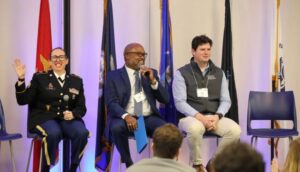
MaryKate Stone, a staff sergeant in the U.S. Army Reserves who is studying for her Doctor of Education (EdD) in Educational Leadership spoke about her desire to better support veterans who want to become teachers themselves. Her research, focused on easing the transition to education careers after service, includes one very important question: What can schools do, and what can the military do to support that transition? “Many of us experience a consistent theme: it’s difficult to transition in so many ways. Our benefits are a nightmare to navigate, and that’s why I’m so appreciative to the team here at SNHU, because you made that process seamless.”
Samuel Norton, a veteran and Engineering student in his senior year, spoke about his experience finding and enrolling in his program after leaving service. He shared how SNHU was able to accept many of his previously earned college credits and provide credit for military learning through his Joint Service Transcript (JST).

The day concluded with a dynamic panel of higher education leaders who work with military-directed learners facilitated by CHEPP’s Executive Director Jamie Fasteau. The panel included Director of Military Education Benefits Joseph Melim, Military Employer Relations Partner Jim Lindsay, and Military Academic Advisor Dr. Elizabeth Pierce, from SNHU, and Director of Military and Veteran Services Kalyn Ryll at the University of New Hampshire (UNH). The panelists shared actionable strategies to strengthen student support systems and sparked audience-driven conversations aimed at driving real campus change. The panelists shared how important it is to have a dedicated staff to help military-connected learners connect with the right resources along with good relationships to other services such as accessibility offices, career advising, and student financial aid.
As the event came to a close, there was a shared sense of commitment to keep pushing for progress. CHEPP’s latest report is just one piece of the puzzle, highlighting actionable recommendations for policymakers and higher ed leaders.
We want to extend a huge thank you to our SNHU colleagues, partners, speakers, and everyone who joined us for making this event both meaningful and inspiring.