
Linel stopped out of college more than once. After a torn ACL, dealing with student loan debt, navigating COVID-19, and working, she gave up on the idea that she would finish her degree.
Linel’s story is not unique. There are nearly 38 million working-age Americans with some college and no credential or degree. According to Trellis’ Some College, No Credential (SCNC) survey, when asked why they stopped out of college, 35% of these learners cite personal finances, 32% point to family and personal reasons, and 25% raise college cost. Despite these barriers to re-enrollment, 73% of SCNC learners agree that “completing a degree would improve career earnings and potential.”
Unfortunately, SCNC learners don’t have a lot of re-enrollment options that will accommodate the obstacles that disrupted their college enrollment in the first place. When stopped-out learners re-enroll, they often do so as a part-time student, which can more than double the time it takes to complete a degree than when a student enrolls full-time.
On October 8th, CHEPP joined Trellis Strategies, The Bridgespan Group, Southern New Hampshire University (SNHU), and Duet for a webinar highlighting how Duet’s partnership with SNHU supports students enrolled in competency-based education (CBE) programs to meet the needs of learners who have not been traditionally served by higher education.
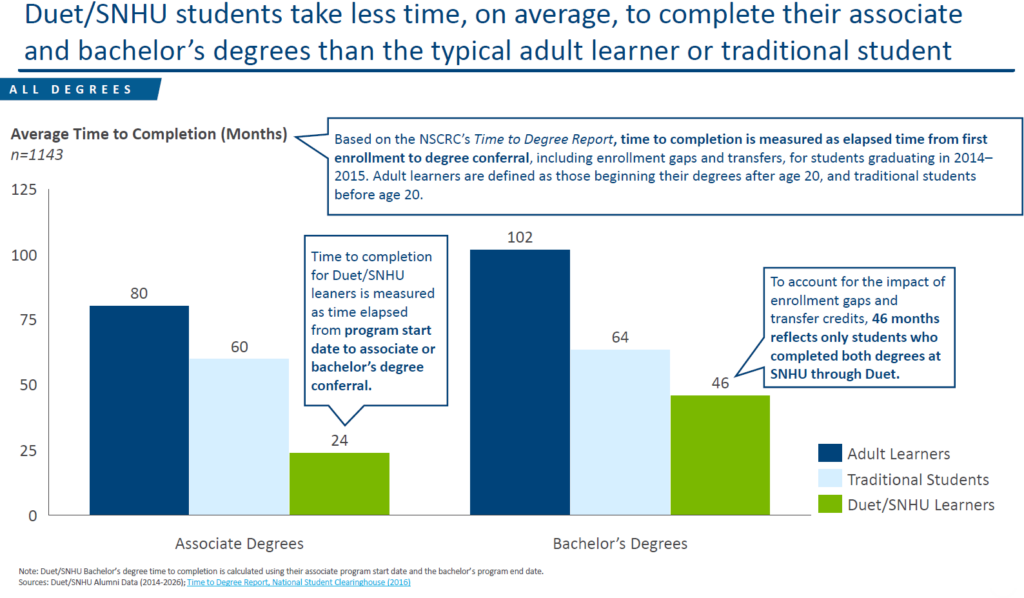
During the webinar, The Bridgespan Group presented findings from a self-study (see Figure 1 below) which indicate students who enroll at SNHU through Duet complete their degree faster than the average for adult and traditional-aged students enrolled nationally. On average, Duet-SNHU students completed their associate degree in 24 months compared with 60 months on average for traditional-aged students and 80 months for adult learners nationally. This accelerated time-to-degree is attributed to CBE allowing learners to fit their studies around their daily obligations paired with a robust academic coaching model.
During the webinar, Linel also shared her own Duet experience. After learning about Duet’s model at an event at The Boston Foundation, she enrolled with 10 college credits and completed her AA and BA in two years. During her studies, she also worked full-time, started a new job, and trained for her first marathon. This was only possible because she worked closely with her academic coach to stay on top of her assignments, completed her projects before and after work, and during her bus commute. She also talked about how the program’s required projects were relevant to her work, making her more productive on the job and while completing her studies.
To learn more about Duet’s partnership with SNHU, read CHEPP’s paper or watch the Webinar here: