
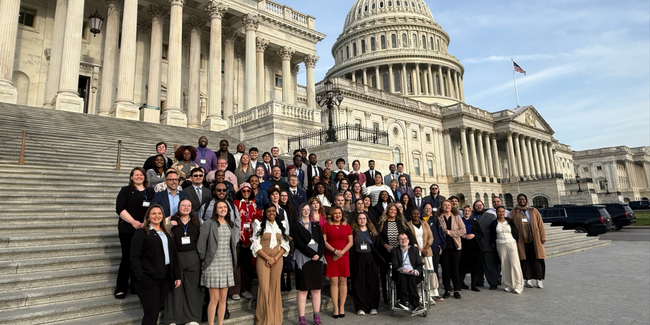
At the largest-ever DC Student Summit, college students brought their powerful personal stories to Capitol Hill to advocate for affordable college and underscore the critical need to protect the Pell Grant.
Each year, CHEPP co-hosts the DC Student Summit with Today’s Students Coalition and LeadMN. Last week was the biggest summit yet, with 80 college students attending from across the country. At the summit, students spend two days learning about the federal higher education policy landscape and how to connect their own experiences to advocate for change. On the third day of the summit, students headed to Capitol Hill to meet with their elected officials. This year, students met with nearly 60 House and Senate offices – both Republican and Democrat. During these meetings students shared how important it is to have access to affordable college options and urged members to consider expanding access to basic needs supports like SNAP and Medicaid. Leading the advocacy priorities for these learners was asking Congress to support the Pell Grant which is currently facing a more than 18 billion dollar shortfall.
Three Southern New Hampshire University (SNHU) students, enrolled through GatewayU in Newark, NJ attended the summit. These students chose SNHU and GatewayU’s Competency-Based Education (CBE) program because it is flexible, affordable, and provides proactive academic advising and other supports to help students stay enrolled and on track to graduate. These learners are driven and resilient, they also believe that without SNHU and GatewayU’s partnership they may not have been able to pursue their college degree.
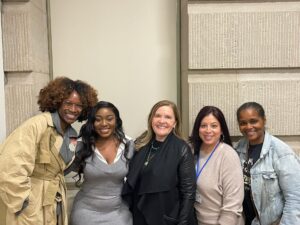
Georgette was a K-12 paraprofessional in Pennsylvania for 20 years. She tried traditional college but was forced to stop-out more than once as she balanced being a mom, other caregiving responsibilities, and her job. She was unsure about whether she could ever complete her college degree. Working as a substitute teacher in New Jersey, Georgette had the opportunity learn more about GatewayU’s teacher pathway program – a registered apprenticeship that recognizes the existing experiences of school support staff while they obtain a bachelor’s degree in order to become a certified teacher. After nearly three decades of work experience and earning her bachelor’s through the teacher pathway program, Georgette will be able to advance her career as a classroom teacher.
Mercy immigrated to the United State from Ghana. As a small business owner and content creator, she enrolled at GatewayU after learning about how she could complete a competency-based degree on her own terms – at her own pace. Once enrolled, Mery finished her associate degree in a year and half, followed by her bachelor’s in just six months. Completing her studies around her own schedule made it possible for her to finish her degree programs faster than she ever thought was possible. With the program cost based on how long a student is enrolled, completing faster saved Mercy money. She is excited to walk across the stage in May and looks forward to applying what she learned to her business endeavors.
Angeline, a mom of two boys who are five and seven years old, dreamed about going back to college for more than a decade. She works as a teaching assistant for English Language Learners (ELL) and couldn’t wrap her head around juggling college with her job and family responsibilities. Through SNHU’s partnership with GatewayU, she recently finished her associate degree and plans to continue her studies in a bachelor’s degree program. She says her success has only been possible because she can complete her studies when it works for her schedule, while she balances her sons’ school and sports schedules along with her job.
In Newark, NJ where the college attainment rate is less than half of the national attainment rate, access to quality, flexible, and affordable college pathways is essential to meeting the community’s needs. Saymah Nah, GatewayU’s executive director, joined these students in DC to share with federal lawmakers how integral the Pell Grant is to the success and sustainability of GatewayU’s programs. With 70% of GatewayU’s students receiving Pell and its program costs matched to the maximum Pell Grant, any reduction or change to Pell Grant eligibility would have significant impacts to student college access.
Historically, Congress has come together on a bipartisan basis to support the Pell Grant. With the current projected Pell shortfall, Congress must once again act to preserve and protect the foundation of college access. Students across the country are counting on it.