
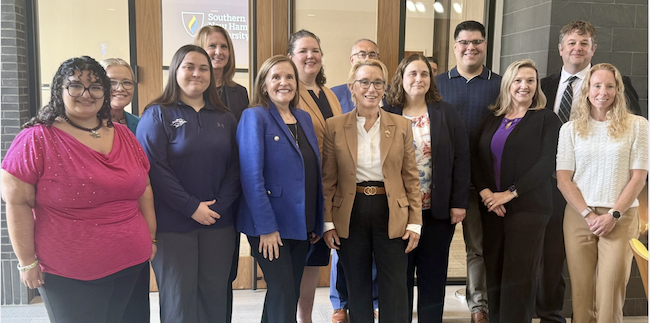
U.S. Senator Maggie Hassan recently convened higher education leaders, students, and community partners for a roundtable on the bipartisan Respond, Innovate, Succeed, and Empower Act on Southern New Hampshire University (SNHU)’ s campus. The legislation would help learners with disabilities access college accommodations by allowing institutions to accept existing documents, including Individualized Education Program (IEP) or Section 504 plans, and requiring clearer information about the accommodations process.
We are grateful to Senator Hassan for her continued leadership on the RISE Act, to Southern New Hampshire University President Lisa Marsh Ryerson for her commitment to ensuring all learners have the opportunity to succeed, to Senator Hassan’s staff for organizing the event, and to every participant who shared their expertise and lived experience:
- Stephanie Ames, Associate Director, Campus Accessibility Center, Southern New Hampshire University
- Jennifer Batchelor, Executive Vice President, Provost, Southern New Hampshire University
- Kelly Lockwood, Assistant Vice President, Community Standards and Accommodation Services, Southern New Hampshire University
- Shannon Lockwood, Assistant Director for the Online Accessibility Center, Southern New Hampshire University
- Emily Freitas, graduate student, Southern New Hampshire University
- Beck Silva Miller, student, Southern New Hampshire University
- Dr. Paul Beaudin, President, Manchester Community College
- Javier (Javi) Sandoval, student, Manchester Community College student and ABLE NH Board Member
- Louis Esposito, Executive Director, ABLE NH
- Sara Scribner, Associate Professor, special education, Plymouth State University
“For learners with disabilities, the transition to college can bring additional barriers, including complex processes and documentation requirements,” said SNHU President Lisa Marsh Ryerson. “That is why conversations like today’s matter. The RISE Act focuses on making that transition clearer and more consistent for students. It also reflects something we believe deeply at SNHU. Access alone is not enough. We must design systems and experiences that give every learner the opportunity to persist, succeed and achieve their goals.”
The roundtable united learners, disability advocates, higher education leaders and policymakers to elevate lived experiences, address barriers to accommodation and build momentum for the RISE Act.
“Living with a disability is not always easy, and in many situations, we have to work even harder to overcome barriers and simply keep ourselves afloat,” said Emily Freitas, a graduate student at Southern New Hampshire University. “By sharing our experiences and speaking up about the challenges we face, we can help create greater understanding, awareness, and empathy. Our voices matter, and when we come together and let those voices be heard, we have the power to make a difference, not only for ourselves, but for others who may be facing similar struggles now or in the future.”
SNHU’s CHEPP co-leads the Coalition on Accessibility in Higher Education with the National Center for Learning Disabilities and supports the RISE Act as an important step toward a clearer, more consistent accommodations process. You can read more about the challenges faced when students with disabilities start college in CHEPP’s blog, Supporting Learners with Disabilities Transition from K-12 to College.