
Don’t miss the latest from CHEPP. Sign up for our quarterly newsletter here.
Artificial intelligence is changing education in profound ways. Every day, we see new opportunities to strengthen teaching and learning, improve how we support our learners, and help institutions work more effectively. We also face important questions about governance, equity, privacy, and accountability. At the same time, policymakers across the country are advancing AI-related legislation, making it even more important that higher education helps shape these conversations.
We cannot be passive in this moment. We have an opportunity to ensure we use these tools thoughtfully, responsibly, and always in ways that advance learning and expand opportunity for those we serve. That requires partnership. Colleges and universities, policymakers, researchers, and technology leaders all have a role to play in building a future where AI strengthens education while maintaining trust, transparency, and a steadfast commitment to learners.
To inform conversations on campuses, in state legislatures, and on the Hill, SNHU’s Center for Higher Education Policy and Practice (CHEPP) launched AI in Higher Education: Learner-Centered Insights for Policymakers and Practitioners. The research series is designed to build a shared base of knowledge to inform and support learner-centered decision-making at colleges and universities, and in policy. As AI continues to evolve, institutional approaches will need to evolve with it. We hope this resource helps policymakers and campus leaders move forward with clarity.
While AI continues to dominate headlines, colleges and universities are implementing new loan and accountability requirements, advancing workforce-focused programs, including changes to Pell, and preparing for another academic year. Meanwhile, learners are continuing to navigate work, school, and their lives, and look for programs and supports that best meet their needs. At SNHU’s CHEPP, we hope our resources help policymakers and practitioners shape decisions around those realities.
Finally, as we celebrate Disability Pride Month, I encourage you to explore our Accessibility Playbook, highlighted below, as well as the important work of the Coalition for Accessibility in Higher Education. Expanding access means continually improving how we design learning experiences and supports so every learner has the opportunity to thrive. That is an ongoing commitment, and one that benefits us all.
With gratitude,
President
Southern New Hampshire University
Research in Action

AI in Higher Education
CHEPP’s AI in Higher Education series examines how colleges and universities are approaching AI today and outlines key considerations for policy, teaching and learning, and institutional strategy. Drawing on research and interviews with experts from a range of colleges and universities, the series provides context for understanding AI’s growing role across higher education.
Explore the series:
- AI in Higher Education: Learner-Centered Insights for Policymakers and Practitioners Introduces the research, learner-centered framework, and key themes across the series.
- AI in Higher Education: A Primer for Higher Education Policymakers and LeadersExplains core AI concepts, capabilities, and terminology to establish a shared foundation of knowledge.
- AI in Higher Education: Teaching and Learning-Applying a Learner-Centered Lens to AI Integration Examines how institutions are using AI to support teaching and learning while considering learner agency, engagement, and academic integrity.
- AI in Higher Education: Infrastructure and Operations – Key Enablers of AI Strategies Explores governance and operational considerations for AI implementation across colleges and universities.
This series provides a deeper understanding of how AI is being integrated across higher education and the key questions policymakers and leaders should consider as its use continues to evolve.

Disability Pride Month
July is Disability Pride Month, a time to reflect on how colleges and universities can work for every learner. One in five undergraduate students has a disability. When we build accessible systems, we help all learners pursue a brighter future, regardless of their abilities or learning styles.
The work of making higher education fully accessible requires a shift from reactive solutions to systems intentionally designed to support all learners. With the National Center for Learning Disabilities, CHEPP co-convenes the Coalition on Accessibility in Higher Education, a cross-sector group working to advance policies and practices that improve accessibility and learner success.
To help institutions move from intention to action, the Coalition recently released the Accessible by Design playbook, which provides practical guidance for university leaders and practitioners. Whether shaping policy, supporting students, designing learning experiences, or leading operational change, readers will find actionable strategies for expanding access and opportunity across their in-person and digital spaces.
To learn more, download Accessible by Design: A Comprehensive Playbook for Higher Education.
Policy Watch
The Federal Budget: Despite the House and Senate Appropriations Committees working through funding bills, it is unlikely Congress will be able to pass a full funding bill by the end of September. With midterm elections in the fall, Congress will likely work to get a continuing resolution passed without a lapse in funding and resulting government shutdown. We signed-on to a letter urging Congress to support key programs, including addressing the $16.9 billion Pell Grant shortfall. We are encouraged that the House Appropriations Committee addressed the shortfall in its Labor, Health and Human Services, Education, and Related Agencies funding bill, but are concerned it was funded by eliminating subsidized student loans.
Workforce Pell: Pell can now be used to pay for short-term credentials. Our latest blogtalks about how colleges, employers, and workforce training can leverage this new federal investment to create ramps to economic opportunity.
Implementation of the Reconciliation Bill: It has been a year since President Trump signed the reconciliation bill that made reaching changes to higher education. The U.S. Department of Education has finalized rules imposing new caps on student loan borrowing that will limit how much new undergraduates and graduate students can take out to attend college. We will continue to monitor how these changes impact student choices. There is also a new accountability rule that limits college program access to federal loans when graduates do not earn more than the average high school graduate.
More Rulemaking: Higher education has been inundated with proposed rules that will have a lasting impact. The Department of Education just completed its negotiated rulemaking on accreditation – look out for the proposed rule soon. The Office of Management and Budget (OMB) proposed a rule to limit federal grants that could have deep implications for research institutions in particular.
Learner Story: Ashley Newman, SNHU Class of 2026

At SNHU’s Spring Commencement, we celebrated more than 25,000 SNHU graduates from all 50 states including:
- 3,700 associate degree recipients
- 16,300 bachelor’s degree recipients
- 5,000 master’s degree recipients
- 19 doctoral graduates
One of those graduates was Ashley Newman, a New Hampshire school bus driver. A mom of two boys, Ashley was preparing to welcome her third child just weeks after her commencement ceremony. While completing her online studies at SNHU, Ashley often worked on her coursework between bus routes, using quiet moments on her school bus and every spare moment she could find to finish her coursework. She said, “as someone working full-time while raising a family, the online format allowed me to continue my education without putting my responsibilities on hold.” In spring 2026, Ashley earned her AS in Accounting, preparing her to take the next step toward a career transition into the field of accounting.
Read, Watch, Listen
 Read
Read
For Most Renters, Eviction Threat Falls with Age. Not for Older Student Parents by Richard Davis Jr. and Nick Graetz
New research from New America finds that while eviction risk generally declines with age, older student parents face significantly higher eviction threats than their non-student peers, highlighting the need for housing and financial aid policies that better support adult learners with families.
 Watch
Watch
New College of Florida: Last Week Tonight with John Oliver (HBO)
John Oliver highlights how the political transformation of New College of Florida has reshaped the institution, highlighting concerns about governance, academic freedom, and the student experience.
 Listen
Listen The Battle Over A.I. in the Classroom by The Daily
This podcast explores how artificial intelligence is redefining K-12 classrooms and the concerns being raised by educators and parents.
In Partnership
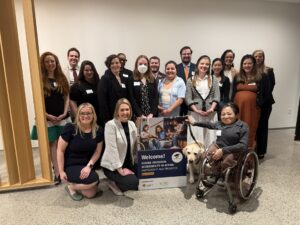
This spring, the Coalition for Accessibility in Higher Education brought together leaders from colleges and universities, disability advocacy, and policy in Washington, D.C., for “Higher Education Accessibility in Action: Partnership and Progress.”
Sponsored by Lumina Foundation and ECMC Foundation, the event brought together cross-industry leaders to discuss the role of partnerships in creating more accessible campuses and the federal and state legislative landscape.
SNHU President Lisa Marsh Ryerson kicked off the event with a reminder: “Accessibility is a promise we make to learners. A promise that they can fully participate in every part of the student experience: learning, advising, internships, labs, and ultimately a credential that unlocks important opportunities across a life.”
You can read a recap of the event with a recording of the panels (including ASL and CART).
On The Road with SNHU and CHEPP
Don’t miss these upcoming releases and events from CHEPP:
- CBExchange: September 30 – October 3
- A new CHEPP fact sheet on workforce and higher ed pathways later this summer