
Don’t miss the latest from CHEPP. Sign up for our quarterly newsletter here.
In 2025, learners, institutions, and the entire higher education landscape faced rapid change. We’ve seen significant federal and state policy shifts—from funding cuts to proposed restrictions on international students—that will impact our education system for years to come. Amid these realities, CHEPP remained focused on our work: elevating the needs of today’s learners and how higher education systems can better support them.
This year, we launched CHEPP Takes, a trusted resource for making sense of higher education policy and understanding the needs of learners. Here are a few more highlights from our busy year at CHEPP:
Published important research, including Unpacking the 40 Million, a report on how higher education can serve the 40 million Americans with some college but no degree; two editions of CHEPP’s Online by Design series on building robust academic experiences and connecting education to workforce and careers; and our latest publication on supporting military-connected learners.
Equipped leaders with actionable fact sheets on pressing issues, from higher education accessibility to transfer credit systems.
Fought for policies that put learners first. Among other efforts, we joined hundreds of higher education leaders to defend Pell Grants and saw our research on transfer credits cited by Senator Maggie Hassan before the Senate HELP Committee in June.
Brought people together to build community and drive change—from co-hosting the Today’s Students Coalition DC Student Summit to convening a roundtable about elevating military-connected learners.
Helped launch a coalition to advance accessibility for disabled learners. We formed the Coalition on Accessibility in Higher Education with the National Center for Learning Disabilities. Building on the insights from Online by Design: How Accessibility is Fundamental to Learner-Centered Design, we partner across sectors to turn practical accessibility strategies into action and break down barriers in higher education.
Spotlighted SNHU learners like Elijah, whose stories remind us why this work matters and what’s possible when our systems meet learners where they are.
None of this would be possible without our incredible partners and readers like you. As we look toward 2026, one thing is clear: the future of higher education must reflect the realities of today’s learners. CHEPP will continue advocating for policies and systems that create opportunity for all.
Thanks for joining us on this journey and in this work. Enjoy the holidays, and we’ll see you in the new year!
Best,
Executive Director,
Center for Higher Education Policy and Practice
Research in Action

In honor of Veterans Day, we joined SNHU president Lisa Marsh Ryerson to host a special event honoring the service and achievements of today’s military-connected learners— including active-duty servicemembers, reservists, National Guard members, and veterans, as well as their families. During the event discussion, learners, higher education experts, and leaders in military learner success explored how higher education can better support military-connected learners. Alongside the event, CHEPP and Today’s Students Coalition released a new report: Advancing Access and Success in Higher Education for Military-Connected Learners. The report shares new research on flexible, career-focused programs and how they can support military-connected learners in making the transition to careers after service.
Thank you to the partners, speakers, and attendees who joined us in Manchester, NH, and amplified the findings from CHEPP’s new paper! Check out the event highlights.
Policy Watch
Grounded in our Learner-Centered Design Framework, we advocated for policies and practices to increase student success across higher education and at the federal level.
In 2025, CHEPP advocated for:
- Flexible models, affordable pathways, and wraparound supports in support of the 40 million Americans with some college and no credential re-enrolling.
- Preservation of college access for low-income learners, by fighting to protect the Pell Grant for all learners, including part-time college students.
- Fixing the broken college credit transfer system, by expanding access to federal financial aid for competency-based education and credit for prior learning, easing the reverse credit transfer process, and increasing data transparency. CHEPP also supported the Fast Track To and Through College Act, which would expand early college opportunities and create a more seamless transfer credit system.
- Increasing access and success for college students with disabilities.
- Expanding financial aid and other supports for military-connected learners.
Right now: We’re closely watching the ongoing Accountability in Higher Education and Access through Demand-driven Workforce Pell (AHEAD) negotiated rulemaking which will inform the implementation of expanded Pell Grant eligibility for short term higher education programs between 8 and 15 weeks, or between 150-600 clock or credit hours authorized under the recent reconciliation bill. As explained in Online by Design: Improving Career Connection for Today’s Learners, CHEPP urges negotiators to require that workforce Pell-eligible programs are designed to meet the needs of learner’s short-term economic success, as well as act as on-ramps for future degree completion and long-term career opportunities through stackability or transferability.
Learner Stories
Making Every Minute Count
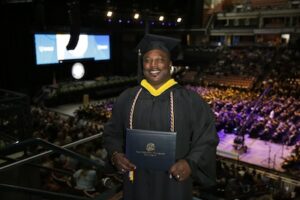
Bobby, a Marine, father, and musician, returned to college at SNHU after his wife encouraged him to finish a journey 25 years in the making. He made time for coursework during downtime from military service, after work, at family events, and in the most unexpected places—like while on vacation with his family at Disney. With a lot of determination, flexibility, and a little creativity, Bobby completed his studies and earned his bachelor’s degree in Operations Management in 2024. During his post-graduation downtime, Bobby plans to trade coursework for rollercoasters. Hear Bobby’s story in his own words.

Celebrating a Life of Service
Daniel Gonzalez is a Jamestown Community College student and disabled Army veteran working towards a career as a licensed nurse. Read his story about the journey from Army veteran to licensed nurse.
Read, Watch, Listen
 Read
Read
Community College Daily: A Marine’s new mission: Building military pathways for today’s students
The article spotlights Marine Corps veteran Lt. Col. Robert L. Glover’s work to build clearer, more supportive pathways for military-connected students at community colleges, helping them transition into civilian careers and higher education.
 Watch
Watch
Service to School Stories Podcast: Empowering Veterans in the Transfer Process
This episode of Service to School Stories explores the growing need for colleges to better support transfers — and how veterans can advocate for themselves through every step of the process.
 Listen
The Key Podcast: How AI Can Smooth Transfer Processes
Inside Higher Ed hosts a timely discussion on the use of generative artificial intelligence in higher education and how technology can support student success goals.
CHEPP’s Year in Partnership

This year, we’ve been honored to collaborate with incredible partners to champion today’s learners—releasing new resources, amplifying learner voices, and driving policy and program innovations that break down barriers to higher education. From connecting with leaders on Capitol Hill to publishing research on accessible, career-connected pathways, these partnerships have made a real impact. Explore our 2025 partnership highlights.
On The Road with CHEPP
-
In 2026, stay tuned for more research, policy recommendations, and events about how higher education can open doors for every learner—connecting degrees to real careers, strengthening accessibility, and unlocking AI’s potential to support education.
- Today’s Students Coalition: DC Student Summit 2026. Registration link.